
404-633-4505 | Join Us On Sundays at 11AM!
404-633-4505 | Join Us On Sundays at 11AM!
Read the latest news for our church.
Jul 03, 2025
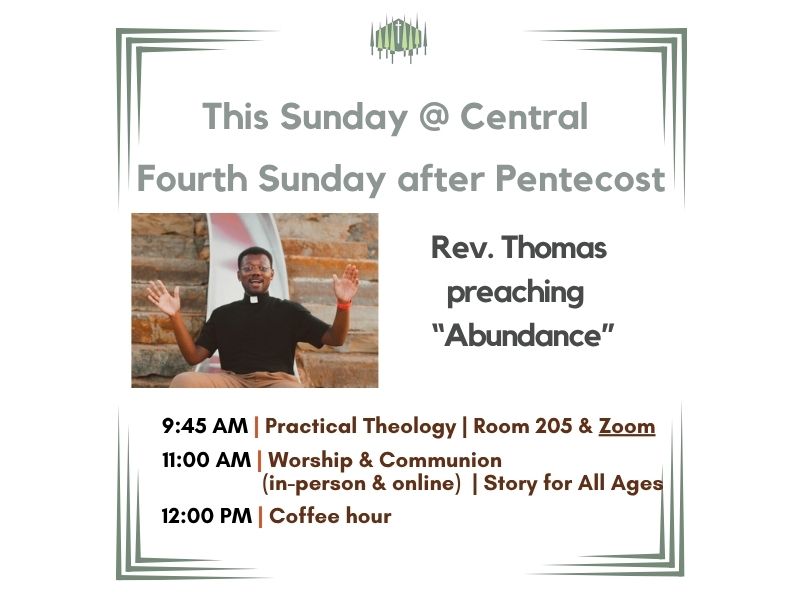
Jun 27, 2025
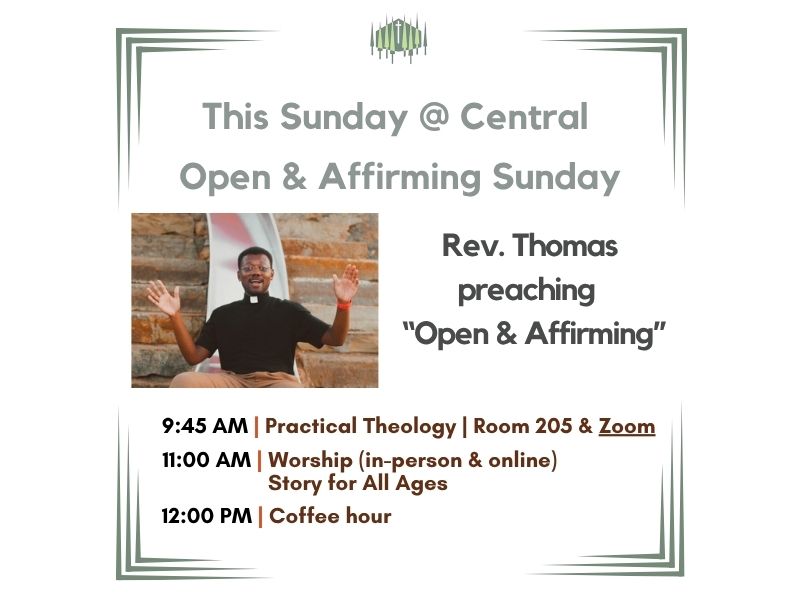
Dear Siblings,
This Sunday is “Open & Affirming Sunday” in the United Church of Christ. Across our denomination, churches will gather and celebrate the good news of God’s love for us and our belovedness. Central already knows a bit about that, as many of you were here when you took the step of becoming an Open & Affirming congregation of the UCC. 20 years later, I hope that these words still ring true:
We affirm the diversity within our midst and beyond our doors and welcome persons of any race, ethnicity, national origin, gender, age, sexual orientation, ability, and economic circumstance to full participation in the life and leadership, ministry and fellowship, worship, sacraments, responsibilities and blessings of participation in our congregation.
Central was the 490th congregation to become Open & Affirming. Just this week, the 1913th church in the UCC adopted an Open & Affirming covenant.
Many of those congregations, like Central, adopted a far-reaching statement of inclusion. We should celebrate that! We should also note that the focus of Open & Affirming has always been on inclusion of sexuality and gender. Indeed, that will be much of the conversation on Sunday.
In a world where the name of Jesus and the love of God are increasingly being invoked in ways that hurt and harm queer people, trans people, and anyone else whose experience of gender or sexuality falls outside of the “norm,” it’s important that we acknowledge the joy of knowing that God made all of creation and called it GOOD… indeed, VERY GOOD!
Sunday will be a celebration! A joyful service filled with the same spirit that carries the Open & Affirming work of the UCC. So, come. Not because you must, but because you may… and because you want to experience a glitter blessing too!
ALSO: Please don’t forget that our Budget meeting will gather right after the worship service.
Be well! And, be gentle to yourselves and one another,
Rev. Thomas
Jun 20, 2025
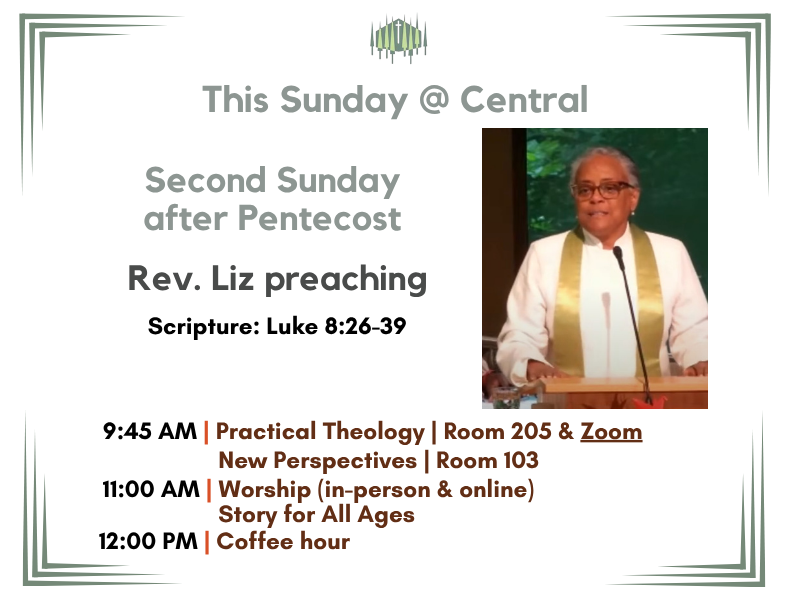
Dear Members, Friends, Siblings, All,
The lectionary text for Sunday is Luke 8:26-29, which I am inclined to give this headline: “Jesus Among the Demoniacs!” How appropriate. Isn’t it wonderful the way the readings in the Revised Common Lectionary—selected randomly about the time I was born—somehow meet us where we are right now, today? It’s spooky, to be honest, and most unsettling.
In Disciplines of the Spirit, Howard Thurman offers a telling that opens this passage for me in a way that makes it unforgettable. Have a look:
In the numerous encounters the Master had with individuals, none is more dramatic than his meeting with a certain madman, who stood staring at Him out of eyes that reflected agonizing turmoil within. From his wrists dangled broken chains. He was regarded by his community as possessed by devils; there were times when he became so violent that, as a measure of collective defense, he was seized and chained to rocks. Even then he could not be restrained when the turbulence within him leaped into muscle, bone, and sinew. The chains burst with the pressure and he would go shrieking through the waste places like a wounded animal. This was the creature who faced Him. He cried out to be let alone. And with gentleness, tenderness, and vast compassion, soft words issued from the mouth of Jesus: “What is your name? Who are you?” And the whole dam broke, and he cried, “My name is Legion!” He might have said: “This is the pit of my agony. There are so many of me, they riot in my street. If only I could know who I am—which one is me—then I would be whole again. I would have a center, a self, a rallying point deep within me for all the chaos, until at last the chaos would become order.”
Fundamental, then, to any experience of commitment is the yielding of the real citadel… Within us all are so many claims and counterclaims that to honor the true self is not easy. (Disciplines of the Spirit, Harper & Row, NY, 1963; pp 26-27)
These feel like times when demon spirits are taking over, running wild. “Jesus, do you notice? The tempest is raging! Don’t you care?” Those words are from Luke 8:22-25, the verses just before our text for Sunday, where Jesus calms the storm on the sea. Now, he has turned to the inner riots where we live. Interesting flow.
This book and this passage are unforgettable to me for more reasons than one. Mr. Clement and I read this book together very early on in our fifty-plus year relationship. (That’s impressive: courting with a soundtrack by Howard Thurman. The copy of the book we shared is so marked and obviously handled that it needs to be put in archival storage before it falls apart.) There were riots in my street back then, too, but I was in good company. The best!
FYI: As I read Howard Thurman these days, I notice that his language is not at all “inclusive.” I have decided that I will not let it bother me. Thurman’s grandmother was born in slavery and knew the most oppressive experience of “the Master” but that fact does not seem to make use of the same name for Jesus hurtful or off-putting for Thurman or his grandmother. I will honor his usage choices and extraordinary gifts as a teacher and pastor. I make no effort to rephrase or “update” it.
We’ll see what all this becomes by way of A Sermon for All Ages in worship on Sunday. Look for us, dear Streamers and Gatherers, online or in the building. Hope you can make it. Until then,
Grace upon grace, love and hugs,
Rev. Liz
Jun 13, 2025
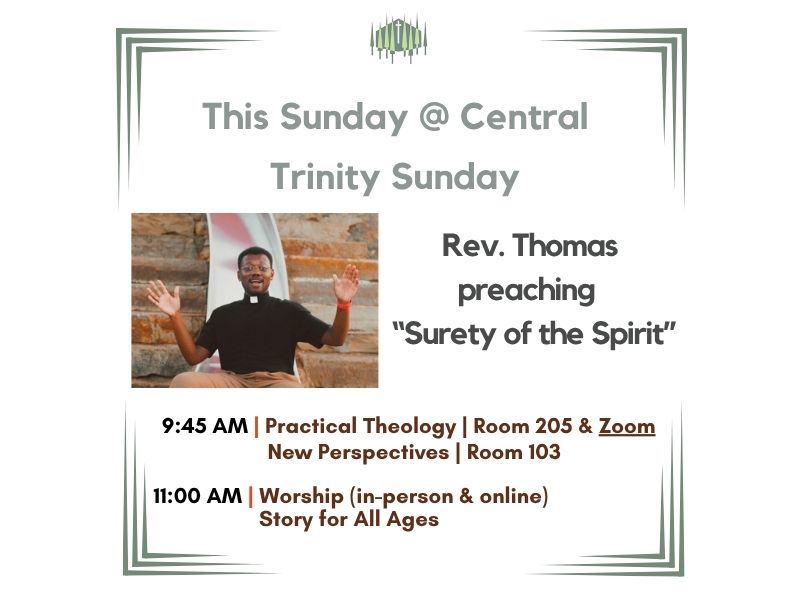
Dear Siblings,
All throughout this week, I’ve had the British hymn “I Vow To Thee My Country” stuck in my head. The hymn is based on a poem called “The City of God” and it’s set to a portion of the movement “Jupiter” in Gustav Holst’s The Planets. The first verse is about Britain. The second verse is about heaven. Certainly, in my thinking of the hymn, I think of the US not Britain. I’ll share a few more thoughts on this on Sunday.
In other news, we’re officially in “Ordinary Time” now. Green is the color for much of the season. This season is the story of us and God. The Holy Spirit plays a big part here! Sometimes, I think “ordinary” is such an interesting way to describe major events. Every part of what we read encountered in our sacred texts and stories seems historic.
But that is kind of the point. When you step back for a moment it really is ordinary.
The terrible kings that ravaged the Northern and Southern kingdoms? Ordinary.
The toil and oppression of the people under those kings? Ordinary.
The small acts of courage and resistance? A big deal perhaps, but still ordinary in the grand scheme of things.
Ordinary time is our time. Amid moments that seem historic and simple, how do we respond to the story of Jesus? How do we find a way to make meaning and a bit of good trouble?
I cannot ignore the events of the world. As I’m writing this note, there are federalized National Guard members on the ground in Los Angeles. Israel and Iran appear to be at war. The final touches are being made for a massive parade in Washington DC to celebrate the 250th birthday of what is now the US Armed Forces. And in cities all across this country, there are predictions that millions of people will participate in what is being called “No Kings” Day in an effort to challenge the president.
Amid all of that, there will be picnics and BBQS. Summer trips will start and end. People will live, laugh, love, cry, and more.
Moments historic and simple all happening side by side. Yes, this is ordinary time… the time for the story of God and us… the story of how we respond to the story of Jesus.
Whatever you might do this weekend, I hope that you carry the courage and confidence of your convictions. I pray that you might reflect upon where and how the Holy Spirit is guiding you.
Regardless of how you spend your weekend, be good to yourselves and one another.
Rev. Thomas
P.S. We are very close to our goal of donating 700 cans of black beans. Can you bring 1 can with you on Sunday? We’ll pass our goal by the start of our service. 🙂
May 30, 2025
Dear Members, Friends, Siblings, All,
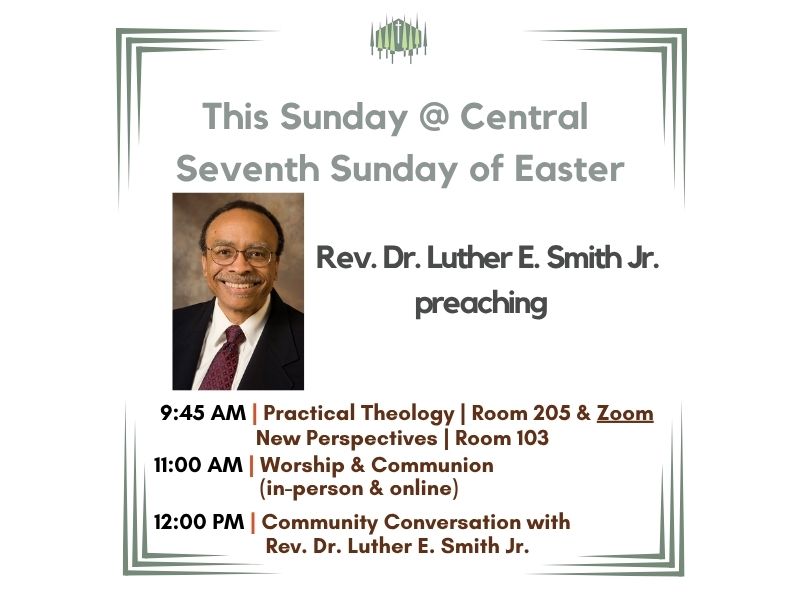
As you will remember, our guest preacher on Sunday will be Rev. Dr. Luther E. Smith, husband of our own Rev. Helen Pearson Smith, gentle and loving spirit, distinguished theologian and educator, and dear friend. Dr. Smith’s latest book is Hope is Here: Spiritual Practices for Pursuing Justice and Beloved Community (Westminster John Knox, 2023). After worship, he will join us for a Community Conversation in the Fireplace Room. The book will be available for purchase.
I trust you are making plans to be with us on Sunday and to stay for our time with Dr. Smith. This is an opportunity I very much look forward to and you don’t want to miss.
In The Monthly magazine that was issued earlier this week, you read about the “Summer of Exploration: A Journey Inward Together” that begins in June. With journeying inward fresh in my mind, I happened upon the following excerpt in Hope is Here and wanted to share it with you here. Under the subheading “Questions for the Quest,” Luther writes:
“Journey” is frequently used to describe how one is living the spiritual life. It evokes images of movement, seeking, engaging new realities and new meanings, the risk. The journey is a quest. A quest inspired by hope. A quest to feed the spirit’s hunger for fulfillment. A quest, whether or not we are aware of it, to give ourselves to God’s dream of beloved community.
A journey’s realities and our feelings about those realities are known and not known. Reliable maps? Maybe. Trustworthy testimony from previous travelers? Maybe. Support from others? Maybe. A strong desire to have a successful journey? Yes. Certainty that it will match our desire? No. Will I be safe? Maybe. Will I be the same at journey’s end. No. Is there an end to the journey? Begin and see.
The questions evoke more questions. Even answers evoke more questions. Questions are not our nemesis. Certainty may be our downfall, but not questions. With questions we quest with a searching heart and humility that are crucial to being alive to wisdom and confusion. The work of hope is accomplished with our embrace of the questions that inform and form us.
We will look to see you on Sunday for worship or Streamers, you can look for us. It will be a great day to be together around the Table of Communion (Streamers, have your elements ready) and to visit with Dr. Luther Smith for questions and conversation. We’ll do our best to stream that, too.
Love and hugs,
Rev. Liz
PS Please don’t forget the 700 cans of black beans for the Toco Hills Community Alliance until June 15th. THCA reminds us that “Hunger doesn’t take a vacation.” We can help keep the shelves full.
May 23, 2025
Dear Members, Friends, Siblings, All,
Anna Dorn is a writer and contributor to The Medium Newsletter. I don’t know her but the headline to her entry this week caught my eye: “Joy is the radical belief that the world is worthy of love.” (Oh, ho! There’s a thought.) She goes on to write:
For a long time, I saw my reluctance to participate in politics as a personal flaw. But German-American philosopher Hannah Arendt might have seen it differently… [P]hilosophy professor Roger Berkowitz draws from Arendt’s work to argue that joy — not outrage, not vigilance — might be the most radical response to political collapse. By “joy” he doesn’t mean cheerful activism or mindful news consumption. He means the kind of joy that shows up in music, in raising children, in watching a lover’s face. He explains that joy is “not naïve optimism,” but “rooted in the radical belief that the world, even as it is, is worthy of love.” And in dark times, that belief can be a way of staying human.
Joy as radical belief, accessed in music, in laughter, in loving eyes–knowing (certainty?) that originates in what Henry James called “the verges of the mind”–not really thought or reason and certainly not proof. Oh, my.
In John 14:27a, Jesus says, “Peace I leave with you; my peace I give to you.” Is that peace like joy? Does the peace Jesus offers reside in that kind of radical belief, evidence notwithstanding, in some sense beyond belief? The sort of thing that only the Holy Spirit can teach? (John 14:26) What does this ask of us, followers of Jesus?
They say questions are better than answers because they last longer. I’ll be with these for a while and perhaps you will, too. Sometimes we read the Bible and sometimes it reads us. And sometimes it chases us around the room.
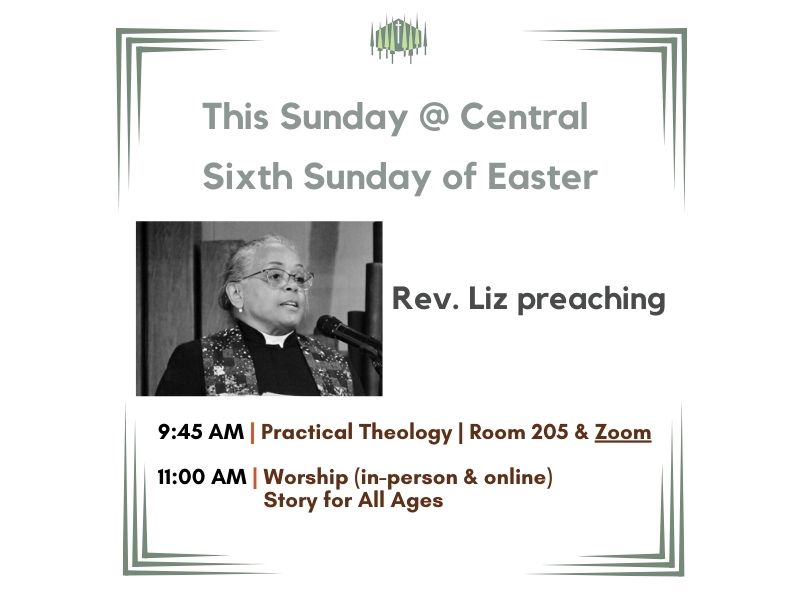
Join us for church on Sunday, Streamers and Gatherers, where we will continue the conversation. And sing and pray and worship together–where we work these kinds of questions out in community. Rev. Thomas is taking time away but I look forward to seeing and being seen with you.
Grace upon grace,
Rev. Liz
PS Anna Dorn says important things about speaking up, too. Find her post here.
May 16, 2025
|
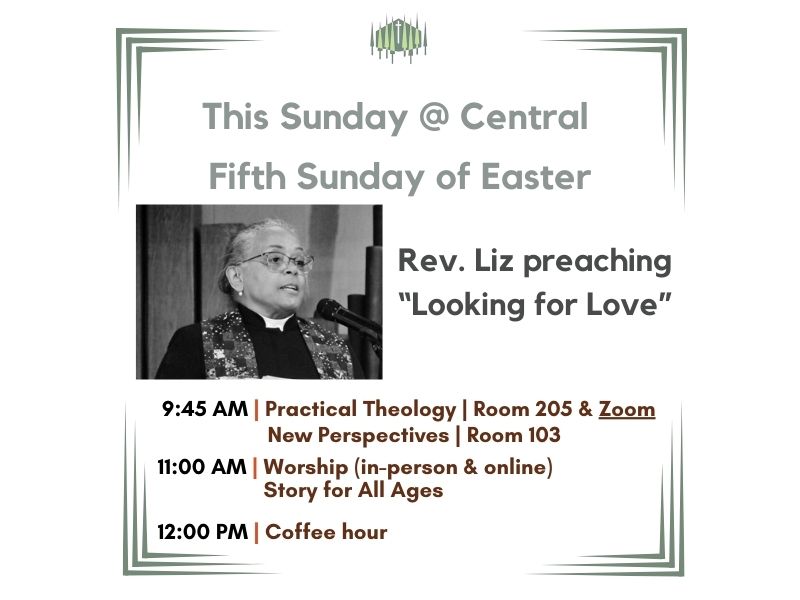
Dear Members, Friends, Siblings, All, As papers are gently unearthed from the piles in my office (home or church!), some things noted years ago seem to speak to right now in spooky ways. Here’s a note to the congregation I served when we were learning to live with “social distancing.” It is a reflection on a piece written by Walter Brueggemann in 1977 on the evangelical (small “e”) and what he termed “face-to-faceness.” “[Face-to-faceness] was that practice and that common presence which told them who they were and what they were to do. Without too much romantic jargon, I suggest it had to do with the corporate interiority of sisters and brothers, the space between and among folks in community which provided energy and stamina for faithfulness.” That was so many years ago and, yet, names perfectly what I have been feeling in these last weeks of sheltering in place and social protocols necessitated by the Covid-19. pandemic. Perhaps you have heard me say, “I go to church for the hugs.” Yes, the music and the preaching, the prayers and all are good. But it’s the hugs, the greetings, “the space between and among” us; the love that grows, the catching up, the noticing “how you’ve grown!” and even the telltale signs of illness and grief we see on one another’s faces–that’s what Sunday worship has always offered to carry on in my life and this faith. Face-to-faceness–“it was that practice and that common presence which told them who they were and what they were to do.” Those are my italics, for sure. Congregations are where we learn together who we are and what we are to do, what our faith requires of each of us and us together. That’s why we come. That’s what congregations are for–to work out together who we are followers of Jesus Christ and what we are to do because we are. (NB: it’s not to get it right; it’s to work it out together over a lifetime.) In our reading for Sunday is John 13:31-35, Jesus addresses the congregation of his disciples because they would be working out the life of faith and could be helped by a few guidelines. And don’t miss this: one of the first things Jesus does after he comes up from the waters of baptism is to gather his congregation for face-to-faceness; Jesus needs a congregation. And then starts the conversation among friends, going along together, as life happens, between meals (sacraments). But I’ve said that before. Come to church, Streamers online and Gatherers in this sanctuary. This is an important space for face-to-faceness, for exploring who we are and what we are to do. Besides, we’ll miss you if you don’t. And, of course, we’ll look for you next time if the Memorial Day weekend takes you out of reach. Before I go, a Wonder Question: What does love look like? Do you have a story to tell about it? Love and hugs, Rev. Liz |
May 09, 2025
Dear Siblings,
This weekend, I invite you to think about your faith journeys. In particular, who are the key figures in your journey of faith? Why might you consider them as key to your engagement with the Divine today?
Our worship focus will be the opening lines of a letter from Paul to Timothy, in which he acknowledges Timothy’s faith development as the product of his mother and grandmother.
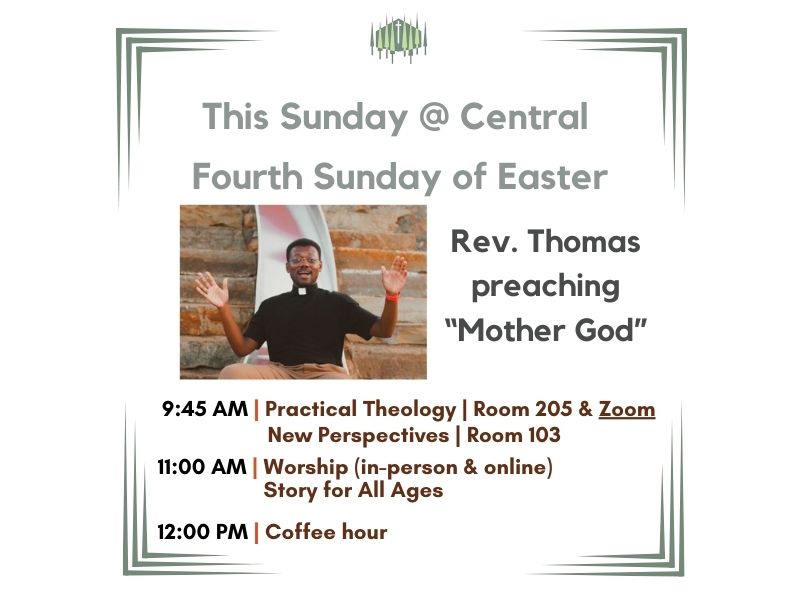
Yes, I chose this text for Mother’s Day! Although our service will not focus on Mother’s Day, it will acknowledge the idea of “Mother God.” In our unceasing and unfailing efforts to fully know and understand the Mystery of God, we apply human language as best we can in the hopes that we’ll find our way. For the vast majority of the history of our faith, God has always been “Father.” It’s still somewhat new to view God as “Mother.” That distinction is slight, but it matters. And, I think it opens up a whole new way of imagining, engaging, and understanding God.
So, come! Our Story for All Ages will talk about the Lord’s Prayer and our sermon will dive into the “grammar of the Spirit.”
As we approach Mother’s Day, it’s important to acknowledge all of the joy, celebration, and “best mom in the world” feelings! I pray that we will also keep in mind folks who don’t have the best relationship with their mothers, folks who wanted to be mothers but were unable due to circumstances and situations that they couldn’t control, and for those who are grieving the loss of their mothers too.
See you Sunday,
Thomas.
May 02, 2025
Dear Ones,
Happy Easter! I know, you’ve put away your Easter bonnets and eaten all the chocolate bunnies that were hiding in the “grass” in your Easter basket. And, yes, everything Easter is marked down to 70% off. But we have eight Sundays in the Season of Easter, including Resurrection Sunday, before we get to the Day of Pentecost. So, I insist:
Blessings on you in this season of New Life and Possibility!
In worship on last Sunday—”the Second Sunday of Easter”—Rev. Thomas took us back to the earliest congregations we would call “Christian” today to remind us that they had very different practices when they met for Communion. He reminded me that we have not always done it this way, even though it may seem like it. Because there was no tradition, they were free to use their imaginations and find their way into what honored the experiences they’d had and their intentions to embody The Way of Jesus. Underline free.
To my surprise and as though summoned forth, a little book by Diana Butler Bass jumped off my bookshelf and opened before my eyes to this page. In The Practicing Congregation: Imagining a New Old Church (Rowman & Littlefield, 2004), Bass urges mainline congregations to develop “the emerging congregational style” that she outlines, and to cultivate the
imaginative power of congregations to move beyond normative patterns and programmatic fixes into a place of doing and being church that embodies the enchantment of the Christian story in the practices of faith.
What? Embody the enchantment of the Christian story? So, that’s what the first followers were doing! I’m in. What Bass says next, I take as an invitation:
The lack of imaginative and fluid retraditioning in a new cultural world “caused” mainline decline. After all, imaginatively fiddling around with tradition is one of the things congregations do.
OK. Let’s do it. Come to worship on Sunday, the Third Sunday Easter, for a slightly “fiddled” Service of Word and Table in a way that opens us to what we do and why. You will notice that the order of worship is shifted a bit for Communion Sunday.
Attention Streamers—all of you will be with us online—please prepare the “bread and wine” of your choice to be consecrated so you can share in the meal. If there are other “elements” needed, we’ll be sure to give you time to be prepared.
Love and hugs, and grace upon grace.
Rev. Liz
(This feels risky. Do you suppose it felt that way for those first followers? We didn’t get the liturgies most Protestants use until the Reformation. What did they do before that?)
Apr 25, 2025
Dear Siblings,
Alleluia! What a wonderful Holy Week and Easter we shared together. Of course, none of this happened on its own.
A little more than two dozen folks joined us on Maundy Thursday, and shared the story of the Last Supper before serving communion to one another. The same number joined us for a dramatic recounting of the story of Good Friday. In those spaces, we sang old and familiar hymns, while introducing a few new ones too.
On Easter Sunday, almost 20 kids hunted for eggs on the playground and in the memorial garden, 80 people were in the Fellowship Hall for the Easter Breakfast, and 180 people joined us for Easter worship.
Again, none of this happened on its own. It took people baking and bringing food for breakfast, folks who stepped out of breakfast to help the Easter Bunny hide eggs, people to buy and cut the bread for communion, an AV tech, singers, banner hangers, greeters, Zoom worship hosts, someone who smiled and said “peace” to a new face in the room, dedicated folks to hang back in Kids Space, an invitation to combine the Story for All Ages and the sermon, a stirring in the heart and mind to simply show up, and whole lot more!
My heart is glad that we are a church of a whole lot more.
Someone with us on Sunday didn’t believe that a church like ours could exist… and now they do. Thanks be to God!
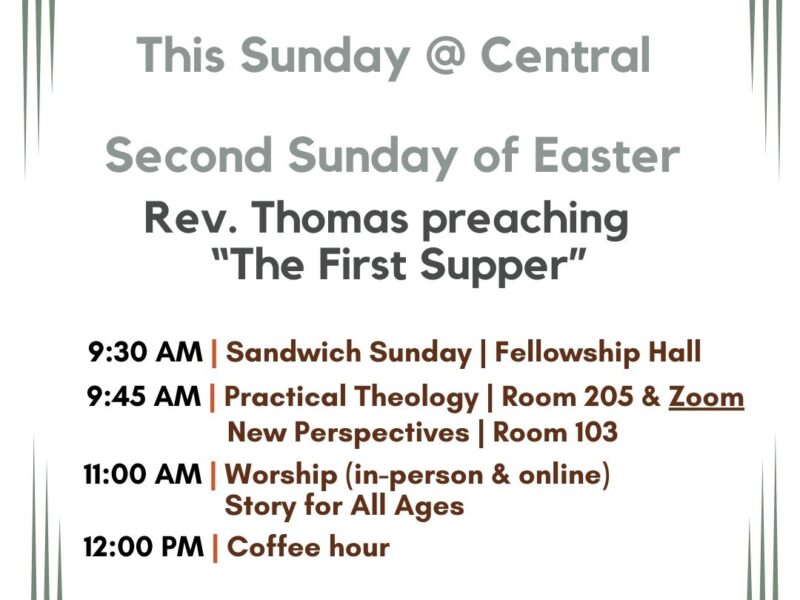
Historically, folks take a short break from church on the Sunday after Easter, but I hope you’ll join us. We’ll talk about the first supper after the Resurrection.
Be well,
Rev. Thomas
Sign up to receive our newsletter!